Whitepaper
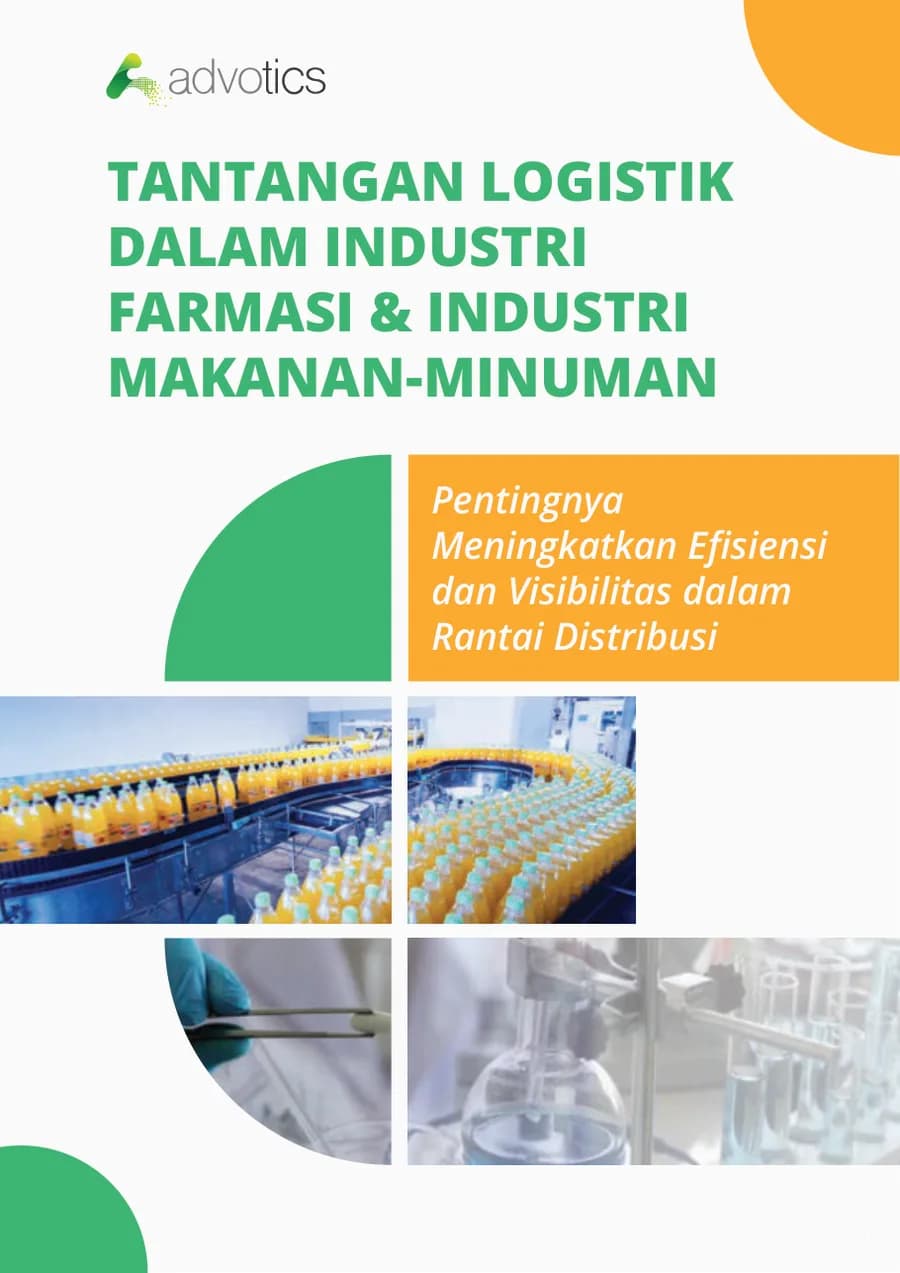
Logistics Challenges in the Pharmaceutical and Food & Beverage Industries
Advotics whitepaper on the top 3 logistics challenges in Indonesia's pharma and F&B industries: diverted drug sales, counterfeits, and the speed of fresh product delivery.
- Published:
- 25 pages
- Document language:
- Indonesian
- Publisher:
- Advotics
Download PDF
The PDF download will be available on this page soon.
Summary
Logistics Challenges in the Pharmaceutical and Food & Beverage Industries (Tantangan Logistik dalam Industri Farmasi & Industri Makanan-Minuman) is an Advotics whitepaper on the three biggest distribution challenges in two industries that kept growing through the pandemic: diverted sales (including drugs sold by unauthorized outlets and cross-channel selling), counterfeit products, and the speed and quality of fresh product delivery. The common answer is visibility: unique codes per product for track & trace, digitally managed warehouses, and optimized delivery routes.
- Counterfeit drugs are estimated at up to 25% of all drugs in circulation in Indonesia (Ministry of Industry, 2021).
- About 33% of food is wasted during distribution, and fresh products spend roughly half their shelf life in transit.
- Unique codes (QR codes, RFID, barcodes) enable authenticity checks and track & trace across the whole distribution path.
- For fresh products, the keys are an accurate WMS and automated delivery routes matched to vehicle capacity.
Key figures from this whitepaper
- pharmaceutical companies in Indonesia, 63.3% of them pharmaceutical wholesalers (PBF)
- 4,224
- Source: BPOM
- pharmacies across Indonesia
- 30,000+
- Source: BPOM
- share of counterfeit drugs in Indonesia's drug circulation
- up to 25%
- Source: Ministry of Industry, 2021
- violations found in 2020 drug & food cyber patrols; ~90% prescription drugs sold without authority
- 48,749
- Source: BPOM, 2020
- of food wasted during distribution
- 33%
- Source: Logistics Bureau
- transport costs for fresh food businesses as a share of cost of goods sold
- >26%
- Source: Cornell University
What's inside
Growth through the pandemic
Pharma and food & beverage were among the few industries that grew in 2020, when Indonesia's GDP fell 2.07%. In 2020–2021, pharma became the second-largest non-oil & gas contributor to GDP after food & beverage. That growth comes with distinctive distribution challenges.
The pharmaceutical distribution chain
Prescription (ethical) drugs, about 62% of drug sales, flow from principal to distributor, then to hospitals and pharmacies; over-the-counter drugs (about 38%) go to modern stores, drugstores, pharmacies, and clinics (GlobalData 2015). Animal health products have their own path to veterinary clinics and hospitals. Pharmaceutical wholesalers (PBF) are regulated by Ministry of Health Regulation No. 1148/2011.
The food & beverage and fresh product chain
The food & beverage industry spans 7,000+ medium-to-large companies and 1.6 million+ micro and small businesses (BPS). Fresh and frozen products need a cold chain, plus attention to temperature, humidity, packing, and stacking so goods aren't damaged in transit.
Mandatory standards: GWP, GDP (CDOB), and GMP (CPPOB)
Good Warehouse Practices govern warehouses that protect product quality. Pharma applies Good Distribution Practices (CDOB in Indonesia), including special storage for pharmaceutical precursors. Processed food applies Good Manufacturing Practices (CPPOB) to prevent contamination.
Pharma challenges: diverted sales, counterfeits, and cross-channel selling
Violations are dominated by drugs sold by outlets without the required expertise and authority, and by unregistered drugs. According to the WHO, about 96% of online drug sites worldwide are illegal. The fix: unique codes per product, authenticity checks, recording the whole distribution process in one system, and track & trace to catch counterfeits early.
Fresh F&B challenges: speed, quality, and cost
Fresh vegetables and fruit last 3–7 days on average, dairy 5–7 days, and meat 3–5 days at 4.4 °C (FDA). Fresh product distribution losses can reach 30–40% of production (FAO). The fix: a WMS for accurate, fast stock movement, picking strategies (zone, pick-to-order, wave), and automated delivery routes matched to vehicle capacity and specifications.
Relevant Advotics products
- DistributionDistribution Management SystemBring your whole distribution process — sales orders, stock, delivery, and invoicing — into one integrated flow.
- WarehouseWarehouse Management SystemFull visibility across the warehouse process — receiving, storing, shipping, and transfers between warehouses.
- Product IDProduct Digitalization SystemQR codes on packaging give every product a unique digital identity — to fight counterfeits, stop cross-border sales, and reward loyalty.
- Delivery PlanDelivery Planning SystemDelivery planning fully integrated with your visit routes and vehicle capacity.
Related articles
- Good Manufacturing Practices (GMP): Definition, Principles, Implementation, and BenefitsGood Manufacturing Practices (GMP) keep products safe and consistent. Learn GMP principles, Indonesia's CPPOB and CPOB, how to apply GMP, and its benefits.
- Good Warehouse Practices (GWP): Definition and 7 Best Practices for Your WarehouseGood Warehouse Practices (GWP) are standards for managing a warehouse so product quality and safety are protected. Learn what GWP covers and 7 ways to apply it.
- What Is a Cold Chain? Definition, Components, and How to Keep Products at the Right TemperatureA cold chain is a temperature-controlled storage and distribution system. Learn temperature ranges, components, example products, and how to prevent spoilage.
Questions about this whitepaper
What are the biggest logistics challenges in Indonesia's pharmaceutical industry?
According to the Advotics whitepaper, the three biggest are drug sales diverted to unauthorized parties, counterfeit drugs, and cross-channel sales. All three stem from a lack of visibility during distribution.
How can counterfeit drugs and products be kept out of the distribution chain?
By giving every product a unique identifier (QR code, RFID, or barcode), verifying authenticity by scanning, recording the product's whole journey in one system, and using track & trace so counterfeits are caught before they reach consumers.
What are CDOB and CPPOB?
CDOB is Indonesia's Good Distribution Practices — a quality assurance system for procuring, storing, and shipping drugs. CPPOB is Indonesia's Good Manufacturing Practices for processed food — guidelines to prevent biological, chemical, and physical contamination.
Why is fresh food distribution difficult?
Because shelf life is short — 3–7 days on average for fresh produce — while fresh products spend roughly half of it in transit. About 33% of food is wasted during distribution, and transport can exceed 26% of cost of goods sold.
What language is this whitepaper in?
The PDF is in Indonesian (25 pages). A full summary is available on this page in English and Indonesian.
Want to see how these challenges are solved in your business?
Talk to the Advotics team and see a demo of the platform used by more than 70 companies in Indonesia.